Does Galvalume reflect heat? Is it Heat Resistant & Reflective?
By  selkoshairi on August 7, 2024
Galvalume. You have probably read thousands of blogs on its benefits and how it’s an excellent choice for your pocket. Look no further than Galvalume, which is as versatile and durable as roofs. Galvalume is a popular coating for metal roofing & siding and is known for its excellent corrosion resistance. But does Galvalume reflect heat? Or is that just a marketing tactic? We cover a massive chunk of this topic from A to Z and its heat-reflective properties.
What is Galvalume?
Imagine a magical alloy bringing together the best of two worlds: that of aluminum, which has rust-resistant and corrosion-fighting powers, and that of zinc, adding strength, durability, and weathering. Welcome to Galvalume, a world where two metals merge into one ultra-strong, long-lasting, and eco-friendly coating, perfect for the modern age.
Galvalume is a coated steel treated with a specialized layer of aluminum and zinc.
It offers, on the outside, toughness and beauty. It protects you from the harsh elements and keeps the steel looking new and fresh for years.
What makes Galvalume unique is its capacity to bear any extreme condition. Scorching summers or freezing winters, it tolerates everything. With this corrosion-resistant rugged coating, you know that your steel will be strong and sturdy against all weather.
Galvalume’s thermal reactivity: how does it work?
We keep saying that Galvalume is favorable for heat Reflectivity – but why? How does galvalume become the best option for reflecting heat? Let’s understand below:
Galvalume’s heat resistance
Galvalume is the most practical alternative in various applications, such as mufflers, tailpipes, heat shields, and catalytic converters. It compares with the most expensive aluminized steel for heat reflectivity and will not discolor up to temperatures of 600°F (316°C). It also oxidizes favorably up to 1250°F. As a result, Galvalume is the best choice for a heat-sensitive range. Whether for your home, commercial buildings, heat exchangers, chimneys, or fireplaces – galvalume is your best friend in every scenario.
Fire Resistance
All of us have seen movies where the roof burns and the house burns right after. Galvalume is a non-combustible roofing option – a massive relief in catastrophic events. When galvalume is built into building components, its fireproof qualities and fire ratings never degrade throughout the entire lifecycle of a building. Be it the workers, or the people living there, it is a reduced risk for both. Municipal fire services breathe a sigh of relief, and your pockets aren’t scorched due to less property damage relief. The adjacent buildings are also not collateral damage – as the Galvalume roofing is fire-resistant.
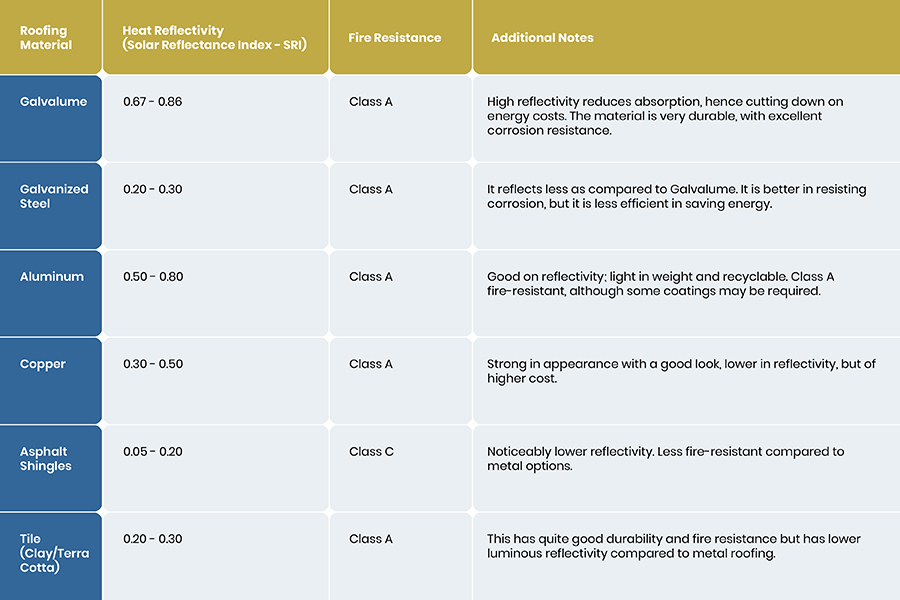
Galvalume roofing exhibits high performance in heat reflectivity and is also highly fire-resistant. Therefore, it is one of the best roofing materials concerning energy efficiency and safety. Other materials, like asphalt shingles, perform poorly in both aspects, while metals like aluminum and copper generally have good fire resistance, but their reflectivity varies.
The science behind Galvalume & heat-reflectivity
Galvalume is generally a coated steel product designed to borrow the best properties from aluminum and zinc. The material’s unique metallurgical composition, combined with the mechanism behind its reflectivity, specifically makes it very special for roofing and applications that need durability and thermal efficiency.
Metallurgical Composition of Galvalume
Galvalume is a steel substrate coated with an alloy of aluminum and zinc. Typical composition is about:
- 55% Aluminum — Excellent corrosion resistance and high temperature tolerance.
- 43.4% Zinc: Offers galvanic protection, thereby increasing the life expectancy of the steel by protecting it from rust.
- 1.6% Silicon: This forms a strong bond between the coating and the steel substrate and enhances the coating for better durability.
Mechanism Behind Galvalume’s Reflectivity
The reflectivity of Galvalume is generally based on high aluminum content. Here’s how it works.
Surface Characteristics:
Aluminum Oxide Layer: The aluminum in the Galvalume coating reacts with the atmosphere to form a thin layer of aluminum oxide. This oxide layer is very reflective and gives a bright, shiny surface that reflects a large amount of solar radiation.
Microstructure: The unique microstructure of the aluminum-zinc coating, with aluminum-rich regions, gives it the reflective capability. Aluminum-rich regions naturally reflect sun radiation and infrared radiation.
Thermal Reflectivity:
Solar Reflectance: Galvalume’s surface will reflect most of the solar energy, and galvalume will avoid heat absorption. This characteristic provides an added advantage in roofing applications for building purposes—keeping the buildings cooler and giving relief from using air-conditioning systems that consume enormous energy.
Infrared Emittance: It also increases the emittance of absorbed heat; hence, it cools off faster once the heat source, like direct sunlight, is removed.
Wrapping up,
In conclusion, Galvalume emerges as the better choice of material due to the metallurgic properties and the high reflectivity factor. Coating aluminum, zinc, and silicon gives it excellent durability and protection against corrosion. Since a significant portion of its material is aluminum, an extremely reflective oxide layer is produced on its surface, reflecting a high proportion of solar radiation so that very little heat is absorbed. This characteristic proves to be incredibly beneficial when Galvalume is involved in roofing in that it maintains more relaxed building interiors and reduces energy costs associated with running air conditioning. In effectively facilitating better heat absorption by the roof, it extends the roof’s life and contributes toward sustainable building practices.